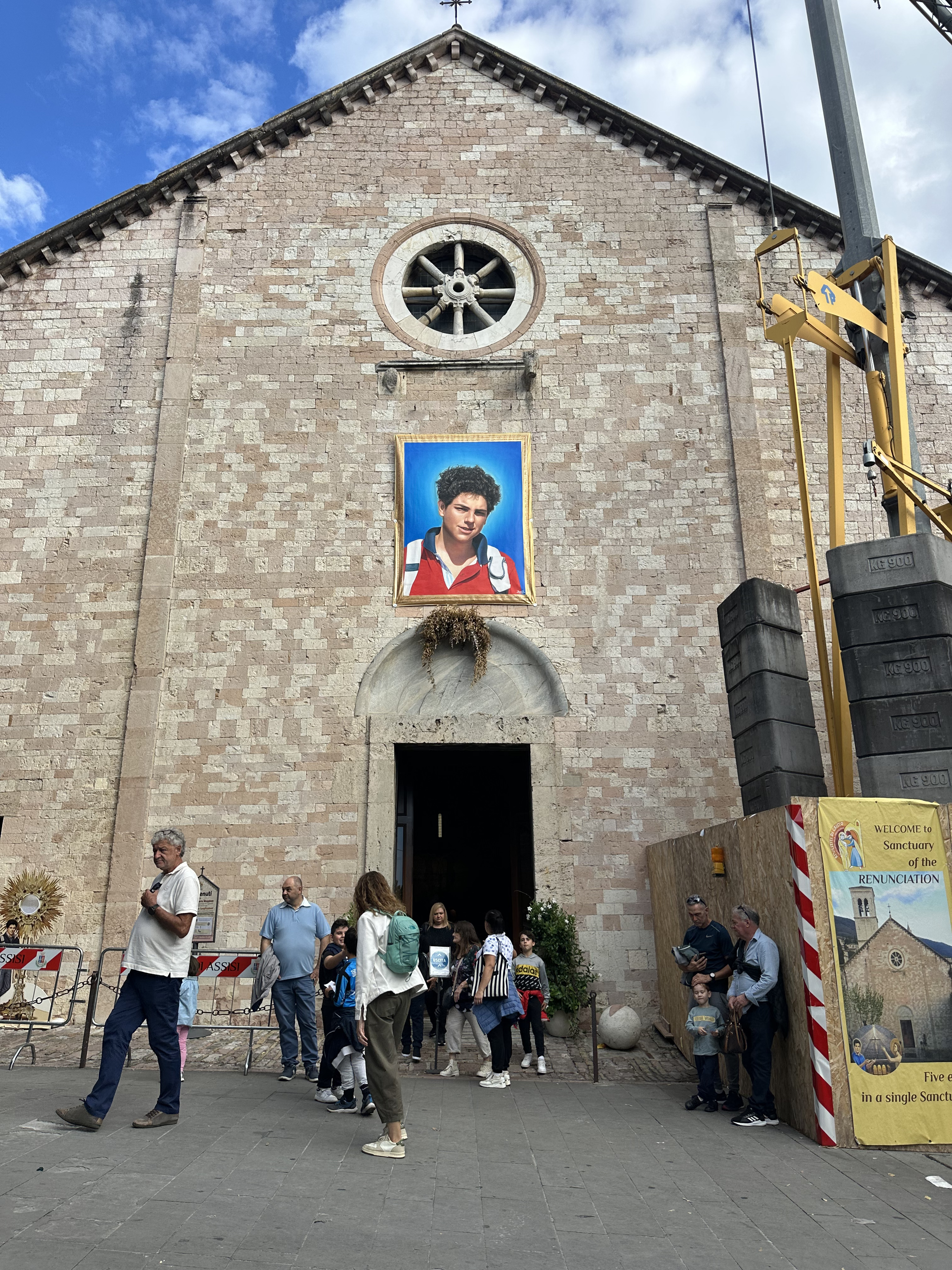
In a glass tomb in Assisi, in a small church carved into a hill in Umbria, there is a teenage boy in jeans, a hoodie, and white Nike sneakers. His face is a silicone mask. His body was exhumed in 2019, treated, and put on display so a million people a year could come look at him. His name is Carlo Acutis. He died of leukemia in 2006 at fifteen years old. On September 7, 2025, in front of eighty thousand people in St. Peter's Square, Pope Leo XIV declared him a saint.
He is the first millennial canonized by the Catholic Church. He liked Pokémon. His most prized possession was a PlayStation. He coded websites in his bedroom in Milan documenting Eucharistic miracles. He was, by every external metric, a normal Italian kid born in 1991. And he is now in the same official spiritual hierarchy as Saint Francis, Saint Augustine, and Saint Thomas Aquinas. Take a minute with that.
The fastest sainthood in modern history
The Catholic Church does not usually rush. The average time from death to canonization is about two hundred years. It involves exhumations, miracle verification panels, theological investigations, forensic medical reviews, and tribunals of bishops arguing in Latin. **Carlo enters the canon **less than two decades after his death, even though the process, on average, takes nearly two hundred years.
Carlo Acutis was beatified in 2020, just fourteen years after his death. He was canonized in 2025, nineteen years after he died. Carlo, who was not a spiritual celebrity in his lifetime, will enter the canon fifteen years faster than Padre Pio did.
Padre Pio, the Italian mystic with the bleeding stigmata who attracted millions of pilgrims during his lifetime, took longer. So did most everyone else. Carlo, who was relatively unknown even in Italy when his cause was first declared, will be canonized before Dorothy Day, the American intellectual who led the Catholic Worker Movement. Though supporters have been pushing for her canonization for decades, her cause has stalled at the Vatican, at least in part because her radical left-wing politics are in tension with the Church.
The New York Post, not exactly a publication of Vatican insiders, was blunt about it: "The cause of a good-looking computer-programming teenager is possibly too irresistible for a Church eager to recruit a new generation of smartphone-addicted youths."
This is the part everyone is dancing around. The Church needs Carlo Acutis more than Carlo Acutis ever needed the Church.
What he actually did Let me strip away the marketing language and tell you what the kid did.
He was born in London in 1991 to Italian parents who were not particularly religious. His mother, Antonia Salzano, was a finance graduate who admits she was not raised devout. "I was converted by my son," said Salzano, who explained that an early faith influence on Acutis was their Polish nanny, Beata Sperczynska.
The family moved back to Milan. Carlo went to school, played soccer, kept pet dogs and cats and made funny videos of them, ate Italian food, played PlayStation, and went to Mass every day from the age of seven onward. He read the Bible. He used his pocket money to buy sleeping bags for the homeless in Milan. He stood up for bullied kids at school. He defended classmates whose parents were getting divorced. He would use his pocket money to help the homeless in Milan, stood up for classmates who were bullied and support those whose parents had divorced.
CS Global Partners He taught himself to code. This was Italy in the early 2000s. The internet was not what it is now. There was no Stack Overflow, no YouTube tutorials in your language, no AI to help you debug. If you wanted to build a website in 2003 you had to read books and figure it out alone. Carlo built a website cataloguing Eucharistic miracles, an online encyclopedia that is still cited by Catholic institutions today.
He also limited himself to one hour of PlayStation per week, by his own choice, as a kind of spiritual discipline. His most prized possession was his Sony Playstation. Acutis talked about limiting screentime as an act of faith. He attempted to limit his Playstation use to one hour per day, as a devotional sacrifice.
That last detail is the one that should sit with you for a minute. A teenager who voluntarily limited his own screen time, twenty years before anyone was talking about screen-time addiction. A kid who looked at the addictive engineering of consumer technology and decided, on his own, to push back against it. In 2003. Before the iPhone existed.
Then in October 2006, he started feeling tired. He thought it was a normal flu. Within days the doctors found acute leukemia. He was diagnosed with acute leukemia and a few days later, on 12 October, he was dead. He was fifteen.
The miracles To become a Catholic saint you need two verified miracles, attributed to the candidate's intercession after their death. The Vatican has medical panels and theological panels that examine every claim. They throw out most of them. Carlo got through with two.
The first was a Brazilian boy named Matheus, four years old at the time, who had a severe pancreatic abnormality that kept him from eating normally. His mother took him to a parish where a relic of Carlo, a piece of his clothing, was on display. She prayed. The kid touched the relic. In 2013, a four-year-old boy with a severe pancreatic abnormality underwent a total and inexplicable recovery after touching a relic of Carlo.
The doctors could not explain it. The Vatican investigated for years. They approved it. That got Carlo beatified in 2020.
The second miracle was a Costa Rican university student named Valeria Valverde who had a bicycle accident in Florence in 2022. She suffered a brain hemorrhage. Her mother flew to Assisi, prayed at Carlo's tomb, and asked for intercession. A few years later, a Costa Rican woman visited Carlo's tomb and prayed for her daughter, who had entered a coma after a traumatic bike accident. That same day, her daughter began to breathe on her own again. Scans of her brain showed that her hemorrhage had disappeared.
The Vatican investigated for three years. They approved it. That got Carlo canonized.
You can believe what you want about miracles. That is between you and whatever you believe in. But the Catholic Church has one of the most rigorous miracle verification processes on the planet, and most claims do not survive it. Carlo's two did.
The Vatican's millennial play Here is where it gets interesting from a media and culture angle. The Catholic Church has been hemorrhaging young members for thirty years. Mass attendance among people under thirty-five collapsed across Europe and the Americas. Vocations to the priesthood are at historic lows in the West. The Church watched an entire generation grow up online and felt itself becoming invisible.
Then someone in the Vatican looked at the file of an Italian kid who built a website about miracles and limited his own PlayStation time, and they saw something the modern church had been missing. A saint who looked like the audience they had lost.
Pope Francis nicknamed him "God's influencer." "Carlo is a message of hope, because Carlo says, 'Yes, you have to use (the internet) for good.' This why Pope Francis called Carlo God's influencer," she told CNN in Assisi earlier this year.
The branding is shameless and brilliant. God's Influencer. A two-word phrase that signals to every kid scrolling Instagram in 2025 that the Catholic Church is paying attention. The Vatican is not a stupid organization. They have been running marketing campaigns for two thousand years. They knew what they were doing.
And it worked. The tomb in Assisi gets nearly a million visitors a year. At his tomb in Assisi, where he's laid out wearing jeans, Nike sneakers and casual top and which is viewable live through a webcam, a steady stream of young visitors now comes to visit. Archbishop Domenico Sorrentino, the Bishop of Assisi, told CNN that the numbers visiting the church where the young proto-saint is on display are "enormous," with almost a million visiting last year and he's expecting that to grow.
There is a webcam. Read that again. You can watch a livestream of a dead saint. This is the most twenty-first-century sentence the Catholic Church has ever produced, and they are not embarrassed about it. They are proud.
The PlayStation question Some Catholic theologians have raised a question that sounds ridiculous on the surface but is actually serious: could Carlo Acutis's PlayStation become a relic?
In Catholic theology, relics come in three classes. First-class relics are body parts. Second-class relics are personal belongings the saint owned and used regularly. Third-class relics are things touched to a first or second-class relic.
Carlo's PlayStation, by strict definition, qualifies as a second-class relic. His PlayStation could technically be categorized as a second-class relic, the Church's classification for a saint's personal belongings. "Getting an extra 5,000 years in purgatory bc it turns out I talked smack to the bl. carlo acutis in a Halo 2 lobby in 2004," one person joked on Twitter.
That joke captures something real. Carlo lived in our world. He played the same games. He used the same operating systems. He scrolled the same forums. The distance between him and the average person reading this is years, not centuries.
The Church has been making relics out of bones and hair for two millennia. Now it has to figure out what to do with a Sony console.
This is the actual crisis of modernity inside the Vatican right now. It is not about doctrine. It is about how an ancient institution that grew up venerating fragments of fingerbones must now deal with a saint whose most beloved possession came in a plastic shrinkwrapped box from a Japanese electronics company.
The relic black market It gets weirder. Because Carlo is fresh, recent, photogenic, and globally famous, his relics have become objects of trade. Sometimes illegal trade. In April, the Catholic Church asked police in Italy to investigate the online sale of some purported relics of Acutis. Their sale is strictly forbidden. An anonymous seller had put up for online auction some supposedly authenticated locks of Acutis' hair that were fetching upward of €2,000, according to the Diocese of Assisi.
Two thousand euros for a lock of hair from a dead teenager from Milan. There is now a black market for the bodily remains of a millennial saint. That sentence is going to age strangely.
A third-class relic was also stolen recently from a parish in Venezuela, two days after the canonization. A third-class relic of Acutis a small, circular piece of cloth was reported stolen from a parish in western Venezuela. The relic, which was kept in a glass reliquary at the Santo Domingo de Guzmán parish in Mérida state, disappeared just two days after Pope Leo XIV declared Acutis a saint.
Someone broke into a church in Mérida, took a piece of cloth from a glass box, and disappeared. Probably to sell it. Probably online. The economics of sainthood in 2025 look a lot like the economics of every other collectible market on the internet. Authentication, scarcity, fakes, auctions, theft. Carlo would have understood it perfectly. He grew up in the world that invented it.
The pope who built websites There is one more thing worth mentioning because it is the kind of detail that makes you wonder if the universe has a sense of humor. Pope Leo XIV, the American who became pope after Francis died in April 2025, has his own digital backstory. In the early 2000s, when the Order of St. Augustine lacked an online presence, it was a young Robert Prevost (then the prior general of the religious order) who designed their first website. Pope Leo XIV is the first pope with an extensive digital footprint prior to ascending to the papacy. So the first millennial saint was canonized by the first pope who used to code his own websites.
You could not write this. The Catholic Church, the most ancient and rigid hierarchical structure in the Western world, just had a moment of synchronicity so precise it looks scripted. A boy who coded websites about miracles was canonized by a man who coded websites for his religious order. One generation handed the spiritual baton to the next, and the medium was HTML.
What it actually means You can read Carlo Acutis several ways. If you are Catholic, he is a sign that holiness is still possible in the modern world. A kid who used a PlayStation and built websites can also be a saint. The distance between holiness and ordinary life is shorter than you thought. If you are not Catholic, he is a fascinating case study in institutional adaptation. The Vatican found exactly the saint it needed at exactly the moment it needed him, and moved him through a two-hundred-year-average process in under twenty years. That is not religion. That is brand management at a level most corporations cannot match.
If you are a millennial, he is your reflection. He played the same games, wore the same shoes, used the same internet. He died young, like a few too many people from that generation did. He left behind a website and a PlayStation and a mother who keeps his story alive. He is one of you. He just got something most of you will not get, which is a glass tomb in Assisi with a webcam pointed at it.
If you are a writer, you cannot ignore this. Because for the first time in centuries, the Catholic Church just sanctified somebody who knew what the internet was. Who used it. Who shaped his short life around it. The internet has finally arrived in the Catholic canon, and it arrived wearing Nike sneakers and a hoodie, holding a PlayStation controller in one hand and a webpage about miracles in the other.
Carlo Acutis is in heaven now, according to the Catholic Church. Or he is in a glass case in Assisi, depending on your theology. Either way, he logged on. And he never logged off.